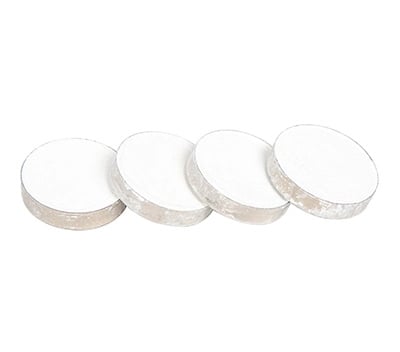
Supertech getter vacuum features:
A high-efficiency getter was applied to the VIP panel(hybrid film+fiberglass core material), and a comparative tracking test of thermal conductivity was conducted with the VIP panel without getter. The VIP was stored under natural ambient temperature and humidity.
Test conditions: T=25℃, relative humidity RHS50% normal temperature tracking, high temperature aging at 100℃, 80℃65%RH~-30℃ high and low temperature alternating aging test.
Product Parameters and Advantages of Getter
Independently developed Cost-effective
01
Good adsorption performance: Water vapor has nowhere to hide:Can treat nitrogen, oxygen, water vapor,Reactive gases such as hydrogen, carbon oxide and carbon dioxide: Produce strong chemical adsorption: Let the water vapor have nowhere to hide
02
The materials used are processed by special processes: Highly active calcium oxide: And add additives containing noble metals and rare earth oxides: Prepared by special process: Effectively absorb water in VIP panel carbon dioxide and small amounts of hydrogen and oxygen: Maintain and increase vacuum within the panel: Extend the life of vacuum insulation panels
New room temperature nitrogen getter, oxygen getter and hydrogen getter: No high temperature activation required, ready to use
03
Maintain the vacuum inside the VIP panel: Extend the life of vacuum insulation panels
04
A high-efficiency getter was applied to the VIP panel(hybrid film+fiberglass core material), and a comparative tracking test of thermal conductivity was conducted with the VIP panel without getter. The VIP was stored under natural ambient temperature and humidity.
Test conditions: T=25℃, relative humidity RHS50% normal temperature tracking, high temperature aging at 100℃, 80℃65%RH~-30℃ high and low temperature alternating aging test
Why VIP Panels Require Oxygen Getter Materials, Hydrogen Getter Materials
Over time, microscopic gases (e.g., oxygen, nitrogen, moisture) can permeate the VIP’s barrier or outgas from internal materials, degrading the vacuum. Even trace amounts of gas increase thermal conductivity, reducing insulation performance by up to 30% and shortening the panel’s lifespan. Getter materials are essential to absorb these residual and permeating gases, ensuring long-term vacuum stability.
How Getter Materials Work in VIP Panels
Getter materials in VIPs operate through chemisorption, where reactive metals/alloys chemically bond with gas molecules:
Target Gases: Primarily oxygen (O₂), nitrogen (N₂), water vapor (H₂O), and hydrogen (H₂).
Activation: Non-evaporable getters (NEGs) like zirconium-vanadium-iron alloys are heated during VIP manufacturing to remove surface oxides, exposing active sites for gas trapping.
Placement: Getters are embedded within the VIP core or laminated into the barrier film.
Function: Continuously absorb gases throughout the panel’s lifecycle, counteracting permeation from external humidity or internal material outgassing.
Zirconium-Based Alloys: High-capacity absorption for O₂ and N₂, ideal for long-term applications (e.g., construction).
Calcium Oxide (CaO): Effective for moisture (H₂O) absorption in low-temperature environments.
Hybrid Getters: Combine multiple materials to target a broad range of gases.